Submission on the Planning Bill and the Natural Environment Bill
Executive Summary
At a high level, RMLA supports reform of New Zealand’s resource management system and considers the Planning Bill and the Natural Environment Bill introduce a number of positive concepts and processes. However, as currently drafted, the Bills contain structural, procedural, and substantive issues that risk undermining certainty, efficiency, and the achievement of high-quality land use planning, development and environmental outcomes. Our submission therefore recommends targeted and, in some cases, material amendments to ensure the new system is legally robust, workable, and enduring.
The key issues that the RMLA has identified are as follows (or watch the recording at the end of this content):
The two-Bill architecture creates risks of inconsistency, duplication, and unresolved conflict where activities engage both statutes simultaneously. Unless the Bills are amalgamated, we recommend a provision requiring joint hearings and coordinated decisions where an activity requires consents under both Bills, and guidance about which statute prevails (or on what basis conflicts are resolved) where the requirements are inconsistent.
We support the funnel concept and standardisation. However, the success of the funnel and goals will depend heavily on national direction. As this has not been developed, it is unclear how the goals will be applied in practice. RMLA recommends a hierarchy among goals or that a statutory mechanism for resolving conflicts is provided.
The purpose provisions in both Bills are largely procedural rather than substantive, and the legal effect of the requirement to “seek to achieve” the stated goals is uncertain and untested. This creates a real risk of disputes over the hierarchy and weighting of the goals. RMLA considers the legislation should adopt a clearer purpose statement and provide greater clarity around the relative weight of goals to guide decision making at all levels of the system.
While the environmental limits framework is sound in concept, there are questions about how it will operate in practice and whether it will deliver the intended environmental outcomes. In particular, concerns arise from the absence of targets, the ability for regional councils to set standards below national bottom lines, and the lack of clarity about how exclusions will operate. For the framework to function effectively, limits and standards must have a clear scientific basis. The importance and magnitude of this task RMLA should not be understated, and RMLA considers the government needs to be more realistic about the time it will take to undertake this work.
The Bills weaken existing protections for Māori rights and interests by replacing operative Treaty obligations with largely descriptive provisions and by qualifying Treaty settlement redress (to be upheld to the greatest extent possible). The Māori interests goal also lacks priority and may be outweighed by development objectives. RMLA therefore recommends the inclusion of an operative Treaty clause, removal of the settlement qualification, and stronger mechanisms for meaningful Māori engagement.
The inclusion of broadly framed regulatory relief powers is not supported and RMLA recommends those provisions are removed or significantly narrowed.
The new bills provide an opportunity to simplify notification, but the restructured provisions and new tests appear to add complexity. The addition of a qualifying resident restriction adds unwarranted and unnecessary complications and is not supported. One option could simply be to require targeted notification where effects are minor or more than minor and all affected persons can be identified, and to require public notification where the effects are more than minor and it is impractical to identify all affected persons.
The proposed permitted activity regime is strongly opposed by members, who expressed concerns about its workability. Requiring all permitted activities to be registered and “determined” appears at odds with one of the government’s stated objectives for these reforms to reduce the number of consents required. As drafted, the regime will be administratively burdensome and costly for Councils and applicants alike.
RMLA recommends that a comprehensive cross-referencing and definitions audit is undertaken. The Bills contain numerous errors in cross-references, incorrect clause numbering, and inconsistent terminology between similar provisions in each Bill. This creates both gaps and overlaps. These inaccuracies will create implementation difficulties and require correction. The Bills also introduce untested concepts and new terminology which increase litigation risk and will likely delay the transition to the new system.
Finally, the statutory timeframes for first-generation instruments appear overly ambitious when measured against current sector capacity. The simultaneous demands across all regions create a real risk that the transition will be compromised and that the objectives of the new system will not be realised consistently.
Overall, we received strong and consistent feedback that members are seeking robust and enduring reform. Our members are calling for bipartisan agreement on an appropriate regulatory framework and a move away from the politicisation that has characterized resource management policy-making in recent times. Members also made a clear plea that this Committee take the time necessary to carefully consider the recommendations made by the RMLA and other submitters so as to strengthen the bills and to ensure those working and operating in the resource management sector can do so with a much greater degree of certainty.
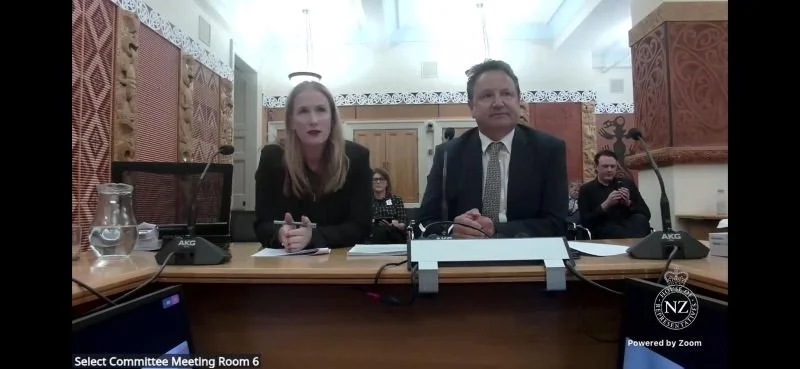
RMLA Oral Submission to the Environmental Select Committee, 12 March 2026. Fast forward to 4:24:50 minutes in.