
Planning Bill and Natural Environment Bill pass second reading: RMLA calls for continued scrutiny as Bills head to Committee stage
The Resource Management Law Association of New Zealand (RMLA) notes that the Planning Bill and Natural Environment Bill passed their second reading in Parliament yesterday, 4 August 2026.
The Bills, which together are intended to replace the Resource Management Act 1991, now proceed to the Committee of the Whole House, where further amendments may be considered before a third reading.
RMLA, which represents lawyers, planners, judges, scientists, engineers, economists, landscape architects and other professionals working across New Zealand's resource management system, made a detailed submission on the Bills during the select committee process earlier this year. At a high level, RMLA supports the Government's intention to reform the resource management system and recognises that the Bills introduce a number of positive concepts and processes, including greater standardisation across plans, regional spatial planning and the establishment of a Planning Tribunal.
However, RMLA's submission also identified a series of structural, procedural and substantive issues that it considers risk undermining the certainty, efficiency and durability the reforms are intended to deliver.
Several of the issues raised in yesterday's second reading debate reflect concerns RMLA has previously flagged, including:
The two-Bill architecture - RMLA's submission warned that splitting the reforms across a Planning Bill and a Natural Environment Bill creates a risk of inconsistency, duplication and unresolved conflict where an activity engages both statutes. This issue featured prominently in the debate, with several members referencing the Parliamentary Commissioner for the Environment's advice that no clear rationale had been established for maintaining two separate Bills.
Unresolved conflicts between goals - RMLA's submission also raised the absence of a clear purpose and hierarchy between the goals set out in the Bills, and the extent to which resolving conflicts between them is left to ministerial discretion. This was a significant theme of yesterday's debate across multiple parties.
Regulatory relief - This new mechanism, which would require councils to consider compensating landowners affected by rules protecting features such as sites of significance to Māori, outstanding landscapes and features, heritage sites, and areas of high natural character was one of the most debated aspects of the Bills. Opposition members cited estimates of the potential cost to councils of up to $1.99 billion, and questioned how councils, which are already facing budgetary constraints could be expected to fund relief in practice. Opposition members also warned the framework would generate significant new litigation as its novel concepts are tested through the courts. RMLA does not support the inclusion of the broadly framed regulatory relief powers.
Environmental protections and the limits framework - RMLA's submission noted that while the environmental limits framework is sound in concept, there are real questions about how it will operate in practice and whether it will deliver the intended environmental outcomes. Related concerns were raised during yesterday's debate, with opposition members arguing the Bills give no particular priority to environmental limits and would allow those limits to be breached where a sufficient reason is given. RMLA considers the environmental limits framework will need considerably more attention as the Bills progress if it is to deliver robust and enduring environmental outcomes alongside the Government's growth objectives.
Māori rights and interests - RMLA's submission raised concerns that the Bills weaken existing protections for Māori rights and interests, replacing operative Treaty of Waitangi obligations with more descriptive provisions and qualifying how Treaty settlement redress will be upheld under the new system. RMLA recommended an operative Treaty clause, removal of the settlement qualification, and stronger mechanisms for meaningful Māori engagement.
Implementation timeframes - RMLA welcomes the select committee's recommendation to extend the transition period from 30 to 39 months, which responds directly to concerns raised by RMLA and others about whether the sector has the capacity to implement first-generation instruments on the original timetable
RMLA reiterates the view expressed in its submission: its members are seeking robust and enduring reform, underpinned where possible by broad, cross-party agreement on the resource management framework, so as to avoid the pattern of "flip-flopping" reform New Zealand has experienced over the past decade.
"The second reading is another significant step in the passage of these Bills," says RMLA President Lauren Wallace. "Our members want to see legislation that is legally robust, workable, and able to command support across the political spectrum, rather than being unwound again by a future Government. As these Bills move into the Committee of the Whole House, we encourage members of Parliament to give further consideration to the issues we and others have raised, particularly around the two-Bill architecture, the regulatory relief framework, environmental protections and the treatment of Māori rights and interests. RMLA remains ready to provide practical, non-partisan technical input to help ensure that the new resource management system for Aotearoa is effective, durable, and fit for purpose over the long term."
RMLA will continue to engage with Parliament and officials as the Bills move through the Committee of the Whole House stage, and will keep members informed of developments through its usual channels, including the RMLA website and forthcoming events.
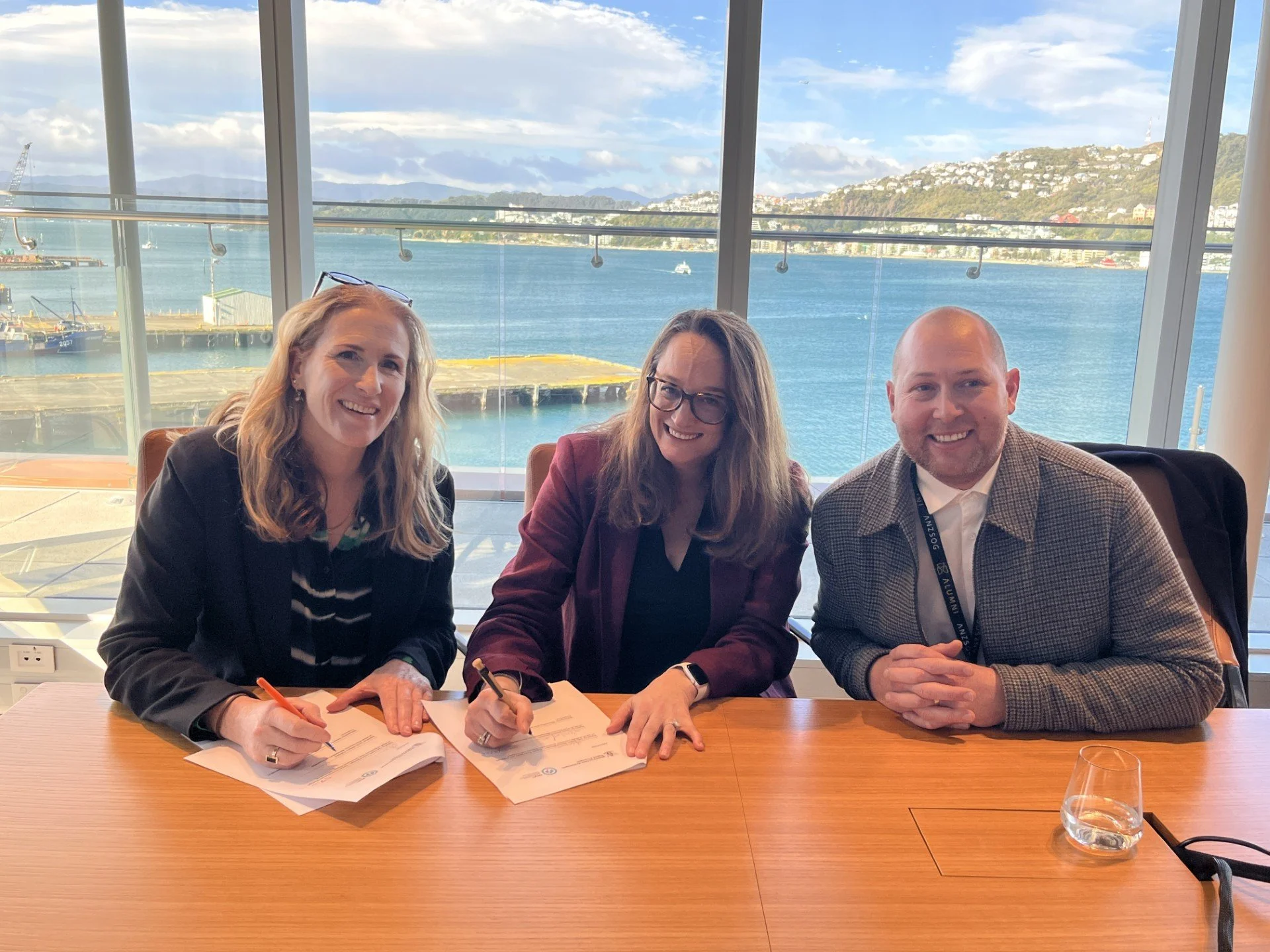
Lauren Wallace (RMLA), Sara Clarke (MCert) and Simon King (MCert)
RMLA signs Memorandum of Understanding with MCERT to support sector readiness
Reflecting this commitment, RMLA is pleased to report that on 31 July 2026 it signed a Memorandum of Understanding (MoU) with the Ministry for Cities, Environment, Regions and Transport (MCERT).
The MoU establishes a collaborative relationship between RMLA and MCERT to support resource management practitioners, and the wider sector, to understand, prepare for, implement and operate within the new resource management system, and to contribute to the system's ongoing improvement. Under the MoU, the Ministry will provide RMLA with early and timely information on reform development and implementation, facilitate connections between RMLA and relevant agencies and implementation partners, and engage regularly with RMLA on emerging issues, risks and capability needs identified by practitioners. In turn, RMLA will continue its existing work disseminating information about the new system through its networks, events and publications, helping members understand the practical implications of the new legislation, and channelling practitioner expertise and sector insights back to the Ministry to inform implementation.
RMLA President Lauren Wallace says: "This is an important and positive step for RMLA and our members, which recognises the value of RMLA's expertise and the role our members play across the resource management system. It will also strengthen RMLA's ability to bring practical, multidisciplinary practitioner insight into implementation conversations."
Importantly, the MoU is a voluntary, and non-binding agreement and it does not limit RMLA’s independence in any way. RMLA retains sole discretion over the views it expresses, the feedback it provides and the activities it undertakes. RMLA will continue to be an independent, non-partisan professional voice, including in relation to the concerns it has expressed regarding the Planning Bill and Natural Environment Bill.
For media enquiries, please email Michelle Behrens or via phone.